 YR Sports Lab
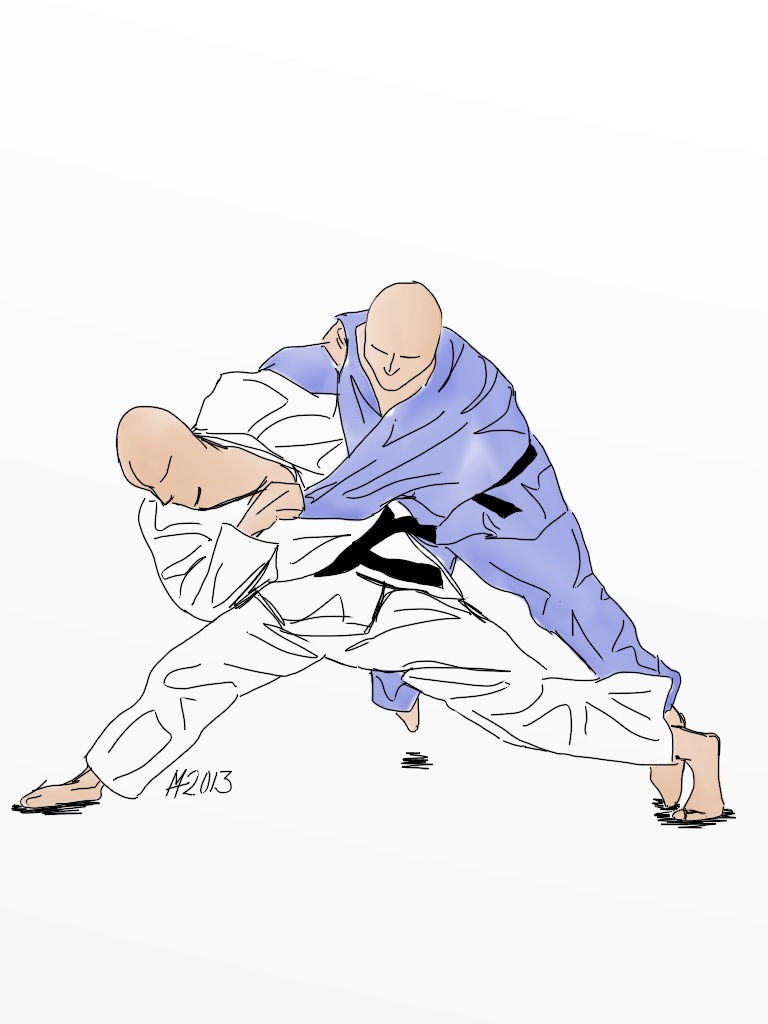
Your opponent walks toward you, you pull the sleeve, turn and extend one leg, and he goes over without your hips ever touching him. That is Tai Otoshi (体落): a Kodokan judo hand technique, called the body drop in English, driven by a sleeve pull, a lapel push and one leg blocking the way. This guide covers where it sits in the Gokyo, the step breakdown, timing and low no-gi entries, counters, IBJJF takedown scoring and judo head-impact research.
1. Origin and Story: Throw No. 6 of Kodokan Group Two
There is no verifiable single "inventing match" or representative figure for Tai Otoshi, so this part sticks to cross-checked classification facts. Wikipedia states it is one of the original 40 throws of Judo developed by Kano Jigoro, named "body drop" in English, classified as a hand technique (te-waza), and still one of the 67 throws in the current Kodokan list. The entry also warns against confusing it with Tani Otoshi, a name that differs by one letter.
Its place in the syllabus can be matched across two sources. Wikipedia's Gokyo no waza entry lists Tai otoshi as the sixth throw of the second group (Dai Nikyo), after Ko soto gari, Ko uchi gari, Koshi guruma, Tsurikomi goshi and Okuri ashi barai, and before Harai goshi and Uchi mata. Judo Info's group-one page adds that the Gokyo originated in 1895 at the Kodokan in Tokyo, and that from 1920 to 1982 it consisted of 40 throws in 5 groups.
Classified as a hand technique: power from pulling, pushing and timing, not lifting
Wikipedia classifies Tai otoshi as a hand technique (te-waza), and Judo Info describes it as a forward hand throw that produces strong force with little contact, relying on timing and kuzushi (off-balancing) rather than lifting. Harai goshi and Uchi mata sit in the same syllabus group, so reading them side by side shows how different throws solve the same problem.
For other throws from the same group, see our Harai Goshi and Uchi Mata guides. As for modern teachers, the no-gi Tai Otoshi instructional reviewed by BJJ More is taught by Satoshi Ishii, whom Wikipedia lists as the 2008 Beijing Olympic judo gold medallist in the +100 kg class. That only identifies the instructor of that course; it does not mean Tai Otoshi is his signature throw.
2. Mechanics: Pull the Sleeve, Rotate, Push Over the Leg, Keep Weight on Both Feet
Judo Info's technique page states the core idea plainly: this is a forward hand throw which relies on timing and kuzushi rather than lifting, with power from a fast rotating action. The table below follows its steps, with sources marked.
- 1. EntryEnter with your legs spread, in a single step (Judo Info)
- 2. Sleeve pullPull strongly on the sleeve with both hands (Judo Info)
- 3. Rotate them around youKeep pulling the sleeve so the opponent rotates around your body (Judo Info)
- 4. Push over the legUse the lapel hand to push the opponent over your outstretched leg (Judo Info)
- 5. Weight on both legsSpread weight between both legs, evenly or roughly 60/40, and rotate powerfully so the opponent cannot recover balance (Judo Info)
Judo Info's most important cue is: emphasize the action of your hands, and do not use your hips to throw. Train to enter quickly in a single step so you can use a brief opening. Grapplezilla adds a BJJ view: grip high, but the actual contact point is near the opponent's calf or ankle, which gives immense leverage, attacks both highline and lowline, and leaves you in an excellent top position. The contact-point description is Grapplezilla's; Judo Info does not spell it out.
3. Entry Timing and Setups
The timings below are drawn from Judo Info, BJJ More and Wikipedia. They are technical descriptions, not statistical conclusions:
First, when the opponent is coming toward you. Judo Info says the throw is easiest when the opponent is moving into you; you pull the sleeve and rotate, sending him over along his own forward momentum.
Second, after a leg throw. Judo Info notes it is often combined with leg throws that set the opponent up. The table of contents of the Satoshi Ishii course reviewed by BJJ More includes an Ouchi to Tai Otoshi combination; compare it with our Ouchi Gari guide.
Third, as a counter. Judo Info's list of counters includes the pairing "Kosoto-gari countered by Tai-otoshi", and Wikipedia's Nage-waza Ura-no-kata entry lists Tai otoshi being used against Uki otoshi and Uchi mata (the entry also notes that in 1950s footage Mifune actually countered Uchi mata with O guruma). Note that Judo Info explicitly says that list comes from a kata that is not a recognized Kodokan kata, so treat it as illustrative only.
Fourth, in no-gi, go low and tie it to the Russian tie. The BJJ More review says the course focuses on low Tai Otoshi and advises combining it with the Russian tie grip to make it work without a gi; it also lists a one-hand Tai Otoshi variation. This is a single review source, so use it as a setup illustration only.
4. Strengths and Limitations
| Strengths | Limitations |
|---|---|
| Can be thrown from several different grips, giving more options (Grapplezilla) | Needs a one-step entry and exact timing, and must be studied thoroughly to work against a resisting opponent (Judo Info) |
| High grip with a low contact point gives leverage and threatens both highline and lowline (Grapplezilla) | Relies on kuzushi and timing rather than lifting the opponent (Judo Info) |
| Usually ends in an excellent top position (Grapplezilla) | Without a gi you need a low entry paired with grips such as the Russian tie (BJJ More) |
| Produces strong force with little contact (Judo Info) | Can produce one of the hardest falls in judo, so landing control matters (Judo Info) |
| Under IBJJF, a takedown from standing to the back, side or seat with 3 seconds of control scores 2 points (Gymdesk) | Takedowns from the knees score nothing (Gymdesk) |
5. Common Counters
Most sources cited here are written from the attacker's side and do not list dedicated defender answers, so we mark which points the sources state and which are inferred from them:
First, a traditional counter pairing. Wikipedia's Nage-waza Ura-no-kata entry lists Tai otoshi as countered by Kotsuri goshi (spelled as in that entry). The entry credits the kata to Mifune Kyuzo but gives no year and says nothing about how well the pairing works in live play, so read it only as "traditionally there is a matching answer".
Second, do not let the grips form. Since the throw needs a sleeve pull and a lapel-hand push, stripping the sleeve and lapel grips early keeps the pull-and-rotate from starting (inferred from the sources).
Third, do not walk straight into the attacker. Judo Info says the throw is easiest when the opponent moves toward you, so the person who keeps stepping straight forward with weight on the front foot gives the window (inferred from the sources).
Follow-ups when it is blocked
If the opponent retreats or refuses to step in, Judo Info says it is often combined with leg throws, so draw a reaction first and return to Tai Otoshi, for example Ouchi to Tai Otoshi (BJJ More).
If the opponent drops his level and strips your grips, switch to the low entry with the Russian tie or the one-hand Tai Otoshi variation (BJJ More).
For landing and takedown defense from the receiving side, read our BJJ takedown defense and ukemi guide.
6. Competition Frequency and Rule Legality
On rules, Gymdesk's summary of the IBJJF rule book (labelled v6.1, June 2024, still the edition in force) states that the athlete must start on two feet, bring the opponent down onto the back, side or seat, and establish top position for 3 seconds to earn 2 points; takedowns from the knees score nothing. The page does not list which judo throws are legal one by one, so check the latest IBJJF rule book for real competition.
On frequency, IBJJF and ADCC publish placings and brackets but not per-technique statistics, and we found no reliable third-party frequency figure for Tai Otoshi, so we describe it qualitatively only: in BJJ instruction it is presented as a judo throw that can be hit from many grips and is often combined with other leg throws, not as a mainstream weapon backed by statistics.
7. Safety: Head and Neck Impact on Forward Throws
Vacca and colleagues, in a 2020 study in Proc Inst Mech Eng H, recruited 20 children (under 12) and 20 adolescents (12 and over) in judo and fitted inertial sensors to the head and torso of the person being thrown. They were thrown with two backward techniques (Osoto Gari and Ouchi Gari) and two forward techniques (Ippon Seoi Nage and Tai Otoshi). In the adolescents, linear head acceleration peaked higher in Osoto Gari than in Tai Otoshi (p = 0.03), and non-expert adolescents had higher risk in backward throws. The authors conclude that training head and neck control during falls from a young age matters. This is a small study in children and adolescents, not adult BJJ data, and it does not mean being thrown by Tai Otoshi is safe.
・The person thrown rolls forward over the leg, so drill breakfalls (ukemi): chin tucked, back rounded, slap the mat with the arm instead of posting the hand
・The thrower keeps hold of the sleeve to help the partner land under control instead of slamming him into the mat
・Beginners should go slowly on thick mats; Judo Info notes the throw can produce one of the hardest falls in judo
・If you feel lasting neck, shoulder or wrist pain, stop training and get it assessed
FAQ
What does Tai Otoshi mean?
Tai Otoshi is the Japanese 体落, translated as body drop. Wikipedia describes it as a judo hand technique (te-waza) in the second group of the Kodokan Gokyo, and one of the 67 throws in the current Kodokan list.
Is Tai Otoshi the same as Tani Otoshi?
No, they are two different techniques. Wikipedia specifically notes on its Tai otoshi page that it should not be confused with Tani otoshi. Tai Otoshi is a standing forward hand throw; the names differ by a single letter.
Do I need to lift the opponent with my hips for Tai Otoshi?
No. Judo Info stresses the action of the hands and says not to use the hips to throw. Judo Info says it relies on timing and kuzushi rather than lifting, and the power comes from a fast rotating action, so it needs little brute strength.
Can I use Tai Otoshi in no-gi without a jacket to grip?
Yes, but enter low. A BJJ More review of Satoshi Ishii's no-gi instructional advises tying a low Tai Otoshi to the Russian tie grip so that it works without a gi.
How many points is a Tai Otoshi takedown worth in IBJJF?
Two points. According to Gymdesk's summary of IBJJF Rule Book v6.1 (June 2024), you must start on both feet, bring the opponent down to their back, side or seat, and hold top position for 3 seconds. Takedowns from the knees score nothing. Check the latest rule book.
References
1. Wikipedia contributors. Tai otoshi. en.wikipedia.org/Tai_otoshi (retrieved 2026/11; supports one of the original 40 throws developed by Kano Jigoro, hand-technique classification, the body drop name, the second group, the current 67 throws, and the distinction from Tani otoshi)
2. Wikipedia contributors. Gokyo no waza. en.wikipedia.org/Gokyo_no_waza (retrieved 2026/11; supports Tai otoshi as throw No. 6 of the second group and the eight members of that group)
3. Judo Info. The Gokyo of Kodokan, Dai Ikkyo. judoinfo.com/gokyo1 (retrieved 2026/11; supports the Gokyo originating in 1895 at the Kodokan in Tokyo and the 1920 to 1982 structure of 40 throws in 5 groups)
4. Judo Info. Tai Otoshi (Body Drop), Hand Technique. judoinfo.com/tai-otoshi (published 2014/04/05, retrieved 2026/11; supports the five steps, emphasis on the hands rather than the hips, weight distribution, one-step entry, ease when the opponent comes toward you, combination with leg throws, and the hard-fall note)
5. Judo Info. Forms of Counters. judoinfo.com (retrieved 2026/11; supports the Kosoto-gari countered by Tai-otoshi pairing and that the list comes from a non-Kodokan kata)
6. Wikipedia contributors. Nage-Waza-Ura-no-kata. en.wikipedia.org/Nage-Waza-Ura-no-kata (retrieved 2026/11; supports Tai otoshi used against Uki otoshi and Uchi mata, being countered by Kotsuri goshi, and the kata credited to Mifune Kyuzo)
7. Joshua K. Top 7 Gi Takedowns for BJJ. Grapplezilla, 2020/07/09. grapplezilla.com (retrieved 2026/11; supports the several grips, the high-grip low-contact leverage, and the strong top position; the article gives no statistics)
8. BJJ More. New Wave Tai Otoshi No Gi, Satoshi Ishii (instructional review). bjjmore.com (retrieved 2026/11; supports the low no-gi entry, Russian tie, Ouchi to Tai Otoshi and the one-hand variation; a third-party review, not the instructional itself)
9. Wikipedia contributors. Satoshi Ishii. en.wikipedia.org/Satoshi_Ishii (retrieved 2026/11; supports the 2008 Beijing Olympic judo gold medal in the +100 kg class)
10. Gymdesk. The Jiu Jitsu Point System. gymdesk.com (retrieved 2026/11; summarizes IBJJF Rule Book v6.1, June 2024; supports 2 points for a takedown, the standing start, 3-second control and no points from the knees; a third-party summary, not the rule book itself)
11. Vacca L, Rosso V, Gastaldi L (2020). Risk assessment in different Judo techniques for children and adolescent athletes. Proc Inst Mech Eng H;234(7):686-696. PubMed PMID 32292102 (supports the head-acceleration comparison among four throws including Osoto Gari and Tai Otoshi, and the higher backward-throw risk in non-experts)